
Short Takes 2
In the short-takes posts I write about some concepts, phrases, models, ideas, whatever related to my work and life. As these are likely to be known to many, the idea is to just document these together, rather than go into details of these. Will keep updating.
-
PuLa
There are very few people, possibly there isn’t even one, who I admire as much as I admire late PuLa.
Thanks to him I got introduced to a lot of good things which have stayed long with me- from eating fish to reading Wodehouse.
An important factor is that this admiration, respect, etc. for PuLa has lived long for me. As I matured, I understood some of his shortcomings and limitations, etc. But I also appreciated some other things which I did not earlier. For example, his writing is limited to Marathi language. It is not easily translated to other cultures, languages, etc. In one speech, he himself says that humor and poetry are rooted deeply in the language in which they are written and cannot be easily lifted and shifted. So he was aware of this. Second, many of his plays (excluding ‘Tuze Ahe Tujpashi’) are musical comedies, lacking drama. His translations (Pygmalion to ‘Ti Phulrani’, Old Man And The Sea- ‘Eka Koliyane’) are also said to lose something in translation. On the other hand, he reworked some portions of Pickwick Papers into- deeply rooted into Marathi- the iconic ‘Batatyachi Chawl’. And when he wrote about people he met in real life (Raosaheb, for example) the balance which he struck between his admiration and knowing that the person he was writing about was not perfect is just breathtaking. I started appreciating this only after a friend pointed it out to me. It is a very difficult balance to achieve.
His fine observation skills, humor, music, etc. are discussed and admired- almost worshipped- a lot. I also admire him because he worked in many areas (writing, films, music, plays, social activities, speaking truth to power, etc.) and in all these areas he did good- almost excelled. He was not always successful (the ‘Subkuch PuLa’ movie ‘GuLaacha Ganpati’, for example). But wherever he went he created a happy place. I don’t know a single- a single- person who did this better than him. I am not saying he was Leonardo Da Vinci. But, anyway. In one QI episode Ronnie Ancona called Stephen Fry a renaissance man. I think PuLa was the same.
In one interview PuLa mentions that he wrote as if he was speaking to someone sitting in front of him. Because I admired his writing I also picked this way of writing to some extent (Wodehouse must have contributed, as well). And at times it is annoying. Why should I write that way when I am writing some technical notes? It makes you somewhat dependent on mostly apathetic readers.
Perhaps the thing that I admire most in him is that he was very appreciative of quality in people and things. Here by appreciative I mean he spotted, praised, and encouraged talent early on. Here are some examples, the first performance of late Bhimsen Joshi in Pune was at PuLa’s place. The first letter saying ‘I liked your poems’ to the then unknown poet Mahanor was by PuLa. He was the first to support the Dalit literature (He wrote a forward to Anand Yadav’s book and told Narayan Surve that his poem MoneyOrder stunned him). I may not be a people person like PuLa but I hope and strive to appreciate good things like he did.
-
Madeleine moment
Also known as involuntary memory. What was the most recent (and somewhat dramatic) Madeleine moment you experienced? I recently spent a few weekends away from city. And once saw quite a few fireflies. Some memories were triggered. But those were neither dramatic nor quite close to heart. I should meditate more.
-
Language and script (in entertainment)
Language is something that is primarily spoken. Script is written. Anurag Kashyap says- in this interview- that from Rangeela onwards movies started using spoken language more than language in its pure, polished form. Their (Ram Gopal Varma and Anurag Kashyap) movie Satya has long been a favorite. But I remember I didn’t understand some of the language nuances and a senior friend had to explain those to me. Even now, the expletive packed language of north Indian cinema is not for me. I do use expletives. But while, for example, the raw language fits well in Gangs of Wasseypur movies, I don’t like blatant use of such language everywhere.
-
Thought subversion is difficult
What kind of thought subversion are we comfortable with? For example, if you are from India/ Asia or were born in a religion that originated in India, would you be able to believe that Karma does not exist, that you are not reborn, that no energy flows thr’ your spine? Well, I could not do it. Christian folks may find it difficult to not believe in Original Sin. Is there any reason why one should think that life is sacred? I don’t bother about past/ future lives but that is when I am thinking/ acting consciously. But the shackles of Karma are difficult to shake off. And as a result I find it easier (and I am almost sure that you’ll find it illogical) to reconcile that while maybe past/ future lives don’t exist, there are Samskara or Saṅkhāra due to karma in this life. But if someone argues with me that all that samskara thing is just escapism non-sense, I would not be able to counter that person well. Yet, such things have a hold on us. Ok, forget religious, spiritual things. Here is some text from Feynman’s book ‘Surely, You’re Joking, Mr. Feynman’: ‘Von Neumann gave me an interesting idea: that you don’t have to be responsible for the world that you’re in. So I have developed a very powerful sense of social irresponsibility as a result of Von Neumann’s advice. It’s made me a very happy man ever since. But it was Von Neumann who put the seed in that grew into my active irresponsibility!’ While I fully understand that it is a healthy attitude, I have not been able to have that even for short periods of time. Why do ideas, thoughts have such suffocating hold on us? Maybe I am someone who takes themselves/ their ideas more seriously than they should. Maybe it is due to culture, inbreeding, geography, system around us. Actionable part is: how can we escape such holds? Maybe create an environment/ ecosystem around us which promotes different thoughts, and think deeply. What else?
-
Test cricket and changing tastes
I did not like Test cricket in the past. It’s not easy to find time to watch a match that can go on for 5 days (for men) and still end in a draw. But sometimes you can watch some of it over the weekend, in the background, in the evening thanks to timezone differences, etc. There’s no doubt T20 and One Day matches are here to take cricket forward and Test cricket will eventually be at their mercy. In fact, it already is. There are fewer Tests and some cricket playing countries have more or less given up on it (in spirit, at least). There is even talk of shortening matches to 4 days, etc. But putting aside instant gratification, if you develop a taste for it you start appreciating a drawn match or series, and even a maiden over. I watched more Test cricket in last 10 years or so than I did before. And in recent years, I have come to the conclusion that if you don’t appreciate Test cricket, you simply don’t understand cricket. Current favorite series- the Ashes, Border-Gavaskar trophy, Anderson-Tendulkar trophy, and maybe WTC. Sadly, there aren’t many countries willing to spend on Test cricket. Teams play but most of the times there’s no heart into it. Teams like Pak, SL have gone downhill due to politics, etc. And capitalism has tilted the balance towards shorter formats. And yet, in the last 5 years, there have been Test matches and series which will be remembered for long.
When the changeover from the likes of Sachin, Dravid, Ganguly was taking place in Indian Cricket, a lot of things were changing- Social media, IPL, Indian cricket had more money, Mumbai was ceding ground to towns like Ranchi. I didn’t like the bearded young fellows of Indian cricket with weird nicknames (Sir, Gabbar), their antics on the ground and in front of camera, and who were comfortable with being- for the want of a better word- themselves. I thought that they were playing to the gallery. And yet today I appreciate Ravindra Jadeja. Frankly, I never thought he would last this long in the Indian side. And while I still think Rishabh Pant should ignore cameras and save risky shots for the IPL, there’s no doubt that he brings a lot to the Indian team. Recent players are more confident, gritty. It’s like Gen Z (or whatever you want to call them) people are more themselves and are breaking the mould like they do in corporate offices. And while each generation is different from the previous one, maybe there are second order effects of social media, and certainly of India’s 1991 reforms as well.
-
Dentists
Why do lady dentists have the habit of engaging you in, you know, small talk when you are in the dentist’s chair?
-
End of an era in Tennis
There isn’t always a single definite point in the arrow of time at which we can say a new era has begun and the old one’s gone. There is a transition which takes place where people, objects, practices, customs, and cultures change, and the old makes way for the new. The transition may not be, but generally is, gradual. While the new is getting established, the old may make and succeed in the last ditch attempts to survive and flourish. And yet the old has to go. It is the way of life. There may be some catalysts during this changeover. For example, the second world war accelerated the dismantling of the British empire; French, Russian revolutions and corresponding changes in regimes and societies, etc.
One such transition has recently taken place… in men’s tennis. The Big Three (Federer, Nadal, Djokovic) are gone; the Big Four if you include Murray.

Well, Djokovic is still not retired and in that sense he will make some spirited efforts to win next few championships and may win some. Just like Federer did. But Djokovic’s play being somewhat mechanical, there is no obvious weakness to work on or gap to bridge (unlike Federer where he improved his backhand dramatically and won the 2017 Aus Open). Most likely, this- being somewhat mechanical- made Djokovic a little boring for me. He’s the best returner, if someone broke his serve chances were he’d break back right in the next game, etc. Of course, his mental toughness was extraordinary (for example, 2019 Wimbledon final). So certainly there’s heart in it; it’s not all mechanical. Anyway, coming back to transition this tweet should give us some idea. Here’s the image from the tweet:
-
Doorman Fallacy
Till the last month I did not know about the doorman fallacy. It does not seem to have a wikipedia entry; so not sure how widely accepted the fallacy is. I vaguely knew the concept. But did not know that there’s a name for it. Very early in my career, with agile and automation (CI pipeline, CD etc.), an excitable department head decreed that we will re-skill all manual testers to be automation testing engineers, and do away with manual and exploratory testing altogether. The exercise did not end as intended. (You know the drill: they hire external consultants, go too far because they miss the nuances and the fine print in excitement, nobody is fully accountable, and people move on to tell success stories.) While imposition from top down helps align and speed things up some of these things take time, and there are second order effects. As I my understanding has widened (and sometimes deepened) about things in general I have started understanding how complex various systems are. Many times we act on them with the illusion of knowledge, control, and confidence. And yet there is so much we don’t know. Of course, we can sometimes act with confidence precisely because of our ignorance. And sometimes we have to act. We cannot have the luxury of time, of understanding everything, etc. (as if we ever can). Then there is this related thing called Chesterton’s fence. I got to know about it via youtube comments. There must be many such related concepts which I am not aware of. I suppose premium schools (for example, IITs), management schools, networks and environment help.
-
Pretty Little Baby
Recently I wasted some time on twitter’s ‘For you’ feed. I follow very few people on twitter and normally my twitter feed is only the people I am following; I don’t visit the ‘For you’ tab at all. I don’t have IG, FB accounts, although I have wasted time on youtube shorts before. Anyway, this twitter ‘For you’ feed doom scrolling is quite extraordinary garbage in economy size. In the past, I thought Indians ruined orkut and quora. Later I understood that it’s not limited to Indians and those sites. Every social site gets ruined. Of course, well curated feed improves even linked-in and twitter. Coming to twitter’s garbage ‘For you’ feed, I know that the algorithm will recommend me more of the kind of content I consume. But if I have not visited the feed in the past, why should I see people with one or two sentence life philosophy, gym fail videos, bro killing it, cuteness overload, linked-in like BS essays and life stories? Of course, there are the kids, daddy’s baby girl, favorite scenes from movies, cats and dogs videos (too many to link), and sometimes light humor which make it somewhat bearable. And this could be the case of frequency illusion but I noticed and came to know that the song Pretty Little Baby is quite popular- I have seen it in videos of kittens and cats, puppies and dogs, other animals, birds, toddlers, etc.
-
That’d be quite a spectacle
I haven’t visited eye doctor recently but it looks clear that I may have to wear age related spectacles. During childhood, I envied people with eyeglasses because I genuinely thought glasses made look people intelligent. Yet not something I imagined I would someday ‘have to’ wear. I know it’s ok but I feel like screaming ‘My eyes, my eyes’.
-
Sleep
Sleep- particularly nightly sleep- is more important than you realize. That’s it. That’s the short take.
-
Women’s ODI Cricket world cup
Well, given the current frenzy around it, the IndWvsAusW ICC WODI WC semifinal match will be forgotten somewhat sooner than you’d expect. But irrespective of who wins the world cup its impact will last forever. Its impact has already happened in a sense. Because, it was not even one particular match as such. And certainly it was not a fluke like some T20 power hitting game. Longer formats test your character better. India Women’s team has been the second best team almost consistently; at least for last few years in all formats. And Aussies are still the best. But I think the impact of match is not about the team; it’s about women’s cricket in India. This impact will take a few (5+?) years to be evenly distributed but it would be like the start of IPL or like Aishwarya and Sushmita winning those beauty pageants. Some things will be there- corruption, favoritism, vested interests, power struggles, scarcity mentality, unprofessional attitudes (acquired.fm podcast’s IPL episode said something like ‘these are just the norms’, way to do business in India, etc.). But there will be more money, more mind-space, and there will be progress. From physical fitness to professionalism. There will be unmatched bench strength. More than that people will be more invested in women’s cricket. Twitter became aware of the match as it progressed in favor of India and went crazy after the win. But the match was not trending earlier. With this win, I hope future matches will be better- for the want of an apt word- supported. To be sure the Aussies will continue to dominate cricket. They are a much better team than India in all areas and are thoroughly professional. And they are likely to remain so. But India will be a force to be reckoned with. And inspired performances like this match will build character. For example, I panicked and felt that India had as good as lost the match when Smriti got out. But maybe only for 5 seconds. I continued watching the match. Gone are the days when people switched off the TV as soon as Tendulkar got out. As the match progressed it’s evident that the Aussies panicked. Harman-Jemi partnership was the big tilt. Sending in Deepti before Richa was also a great move (if I am not reading too much into it). And I felt certain of India’s win when Ashleigh Gardner bowled a few not-wide-but-out-of-reach balls to Richa in the 45th over. When you put someone like Gardner on the back-foot like that and send the ball beyond the rope in the Ellyse Perry region of the boundary then you have arrived.
A lot of factors have gone into getting there. Indian board being the richest because people are crazy about cricket (and there are a lot of people in India), the adjacent possible, the T20 leagues (IPL, WPL, WBBL, Hundred), Harman may be retiring before the next cup, and she has swallowed the bitter pill many times in the past and would like to win the cup, Deepti’s fighting spirit, India has home advantage so would like to win, the 3 defeats on the road to the semifinal stung and possibly awoke the giant, Smriti overcoming struggles against off-spinners, etc. Jemi’s personal struggles (abuse because of her non-cricket activities like dance reels, being targeted by religious losers, etc.) were of course on a different level. Until about 2 years back she was life of the party on the ground. She seemed outgoing, extroverted, new generation, etc. While the change in her presence on the ground from the past to now was visible, I did not know that she’s fighting those battles still. That reminds me that everyone is fighting a losing battle that you know nothing about; so be kinder. Lastly, if you had asked me about a single differentiating factor during close-to-retirement years of Federer, I would have said that he had better chance of winning if he got the first serve in. In the same vein, if there’s one single factor that worked better than any other in the match it was that India kept cool and never let their run rate drop. Any suggestions for the final, you ask? Keep Renuka, Radha in the team, and as a wild suggestion send Smriti in at number 3.
-
Weak minds
This short take may sound like a darker side of me. But there it is. Yet let’s be clear that this is not about a person or a country or a religion. It’s more about weakness of mind that is universal. You and I have such weaknesses- maybe differing in specific aspects. Let’s take a case of a popular twitter persona- we’ll call him Kabra. Well, people from Pune cannot escape this persona if they are on twitter. Talks a lot of sense a lot of time. In that sense he is doing more good work than harm. Science, engineering, etc. And yet possibly due to driven by audience or for content engagement, ends up making compromises. People do that. But then this Orwell quote sums it up- ‘He wears a mask, and his face grows to fit it’. At one point he had written a quite messed up thread on a popular verse from the Gita. Totally screwed up meaning. His thread and replies on it told me that he did not understand the meaning- like AT ALL. And the verse is so popular that you’d think that people cannot get the basic meaning wrong. I explained correct meaning of the verse. No acknowledgement. Later he deleted his old related tweets and created a new thread on the same verse and in doing so failed to admit his old interpretation was wrong. Instead, made it sound like the old thread needed rework as the meaning can be applicable in many situations. My point is that his online persona started looking fake to me. While I have innate- well, maybe not innate- habit of correcting people, after a couple of years post college, I started doing it without any sense of superiority, and to the extent possible, privately- not publicly. With genuine desire to help. But problem is that people are not able to separate their identity from their tweets. Just like programmers think they are the code they write. Such people use their misconceptions, echo chambers, and brute force to ignore reason. These people are maybe suitable for the jobs of bad Presidents or Prime Ministers of some country. I have been wrong hundreds of times and have admitted to being wrong thousands of times. Ha ha. Now you may say that I am confusing one-off incident with the person- sort of like treating a programmer same as the code they wrote. But due to incentives of user engagement such people are supple. They can sense and adapt the narrative to that which is currently popular. These are the people who always like the top ranked male tennis player. A couple of years post the Gita verse thing, he started some youtube show and in one episode attempted to explain science behind a peculiarly Indian idea… you know one of those ideas like rebirth, karma, avatar, etc. Why? Why do rational sounding intellectuals do that? Why can’t they keep these things separate? Follow the rituals if you want. Religion is not a bad thing. I know a lot of reasons why people do this. Yet this Huxley observation hurts me. Maybe not as much as Naipaul’s ‘A wounded civilization’. Because even though criticized for colonial mindset, Naipaul tries to find reasons why people do that. And the reasons also hurt. It may appear more pronounced in Indian mind but is not limited to it. For example, in the Ross-Phoebe evolution argument Ross should have denied even a teeny tiny possibility that the theory of evolution could be wrong. Until proven otherwise- demonstrably, repeatably.
-
Is-Ought Fallacy
Recently, while watching the Everything is everything episode on evolution I came to know about the name for the concept- Is-Ought problem or fallacy. One of the things they missed discussing is that there is no directionality to evolution. (Well, Ajay did discuss about there being no destination, evolution never ends, etc.) But for example, human brains (some parts) are fairly better developed than in other species but may deteriorate over generations if say we leave everything to AGI. Evolution works on Good-Enough principle- not on perfecting principle. (This last statement was from a Robert Full TED talk which has been archived.) Of course, on evolutionary time-scale there could be local maximas.
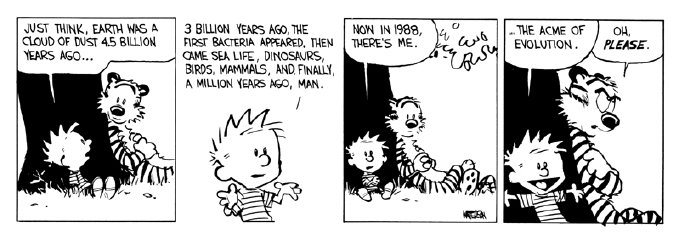
Another thing I learned from the episode is that ‘Science expands knowledge but it doesn’t necessarily expand language’.
-
Content Creation Pressure
They recently stopped making Everything Is Everything(EiE) episodes. I watched a few episodes. I used to read Amit’s blog (maybe 2009-10), and have listened to a few episodes of his The Seen And The Unseen(TSATU) podcast. I learned many things. But I understand why they stopped EiE. Well, Amit’s explanation in the final episode made sense. But Ajay’s reasons resonated. If you have listened to TSATU in the past, a lot of content (particularly from Amit’s side) on EiE was known to you. Of course, the ideas were sometimes put in different contexts, etc. But there was bound to be some repetition. The Sanskrit concept of Nava-rasa (9 emotions(?)) can be packaged in various combinations to create a lot of things. In that sense some ideas are bound to be repeated. Another example- maybe you have read on this blog a few repeated things- importance of naming things, identifying things by their proper names, clean code, SAFe bashing, cognitive biases, etc. When people repeat these things it’s likely because those are close to their hearts- which is true for things repeated on this blog at least. There could be other reasons. One reason, for example, is that those things sell- like dogs feeling sleepy videos or soccer girls rolling their shorts up. But some people are more comfortable with producing what sells than others. And this is where Ajay’s reasons resonated. You have only so much to say; once you’ve said it you can utilize time better by doing some other things, etc. And creating serious content can drain energy. When creating a presentation how many times do you revise the slides? (Is this a case of ‘science does not necessarily advance the language’ mentioned above? Slides? What do you mean slides? If you insist on living in age old days why not call them transparencies instead?) Anyway, bullet pointed talk is still ok. Let’s do one experiment. Say you are going to discuss or talk about some idea for an hour. Whatever the idea you want to present, talk about may be (not lasagna recipe, of course)- just write down what you are going to talk about. Why write the content down? To give it a fixed form. Then see how many revisions/ corrections you end up doing over a couple of days. Read it after 10-15 days. Next, create such write up once every week for say two months on different topics- serious enough, and in-depth and broad enough to interest your colleagues- people more or less in your intellectual bandwidth. It’s difficult. This is why- even though I liked the EiE- I am not sad that they stopped. The versions we see must have taken a lot of work coming up with content, editing, etc. I will consume TSATU episodes and what Amit comes back with next. But I will also watch out for Ajay’s work, if it’s not too specific to economics and if I can grasp it.
-
Content targeted towards audience
When you create content, you may have a certain target audience in mind. Wodehouse wrote stories set in upper class old world England with Earls and butlers because he saw that there was a curiosity for such thing among his readers. PuLa wrote primarily for educated, somewhat nostalgic, middle class Marathi brahmins of his era who lived in the cities. During the process some authors educate their readers. Many Marathi writers before PuLa also wrote for similar audience. But they were stuck in that world. For example, humor by authors like C. V. Joshi before PuLa could not rise beyond certain limits set by the audience it was targeted towards. I think when writers like PuLa educate and elevate readers to a higher plane, they work through/ with the readers. Mangesh Padgaonkar mentions that in some plays Shakespeare added vulgarity, sexual innuendos, etc. at the beginning of the play to get people inside the theater on time. Like Mani Ratnam adding dance numbers at the beginning of his movies. People get in and forget the outside and then the drama starts. Another example, Romeo in early acts describes Rosaline using shallow ideas, and even describes Juliet in abstract terms. His love sound bookish. But in the later acts his descriptions, desires acquire more maturity, spiritual references; the love becomes deep. This is to show his own growth and development as a lover but also to get the viewers invested so that the tragedy at the end hits hard. (This- working through/ with the readers- is not always the case. Some authors may elevate the readers in spite of those same readers (they give them cars when people would’ve demanded faster horses).) Amit educated me in the areas of economics, books, ideas, etc. via The Seen And The Unseen podcast. His approach is scholarly in that he cites/ credits quite a few references, books where he came across those ideas, etc. On Everything is Everything youtube podcast, maybe because they had to work with the readers/ viewers, there were certain limitations- from topics to depth. Can you imagine what kind of content they will be able to create if they changed the audience from the likes of you and me to say people already on a somewhat higher plane? Whether they’ll want to do that may depend on various factors. But it could be one of the reasons they stopped EiE.
-
English grammar
I did my schooling in Marathi medium. English was the third language during school. While written English comes easier to me than spoken; it’s not my first language in either form. And it sounds like an excuse (and at some level it no doubt is) but you may see some grammatical errors here. Sentence construction, order of words, may-might, a-an-the, I-me, would, who-whom, shall, etc. By the way, do people still use shall or is it limited to grandpas?
-
Straw man fallacy
A straw man fallacy is when people counter an argument that’s different from the one actually being discussed. They also don’t understand, or if they understand then they don’t acknowledge the difference. Not exactly closer to what Kahneman calls bias involving substitution where people answer cognitively easier question instead of the actual hard question that was asked.
-
System Dynamics
System thinking/ dynamics is an approach where you look at a group of interacting subsystems as a whole from a viewpoint to understand how they interact with and affect each other and the whole.
In the past, I mentioned “Thinking In Systems”. Weinberg in his An Introduction to General Systems Thinking quotes Tagore poetry: “By plucking her petals you do not gather the beauty of the flower.” (I left both books half read, by the way.) Also, take a look at this video explaining difference between Analysis and Synthesis approaches. If you have an engineering (or related field) background, you are familiar with and have used both these approaches. And yet, statements like Structure generates behaviour immediately hit like a mathematics formula that tells you an absolute truth. Makes sense right away. For example, adding training wheels when a kid is learning to ride a bike may help. Or moving an energy draining person from one team to another seems to improve that person’s as well as both teams’ performance. And it could be one of the reasons why countries want to bring about a change in regime of an enemy country. The linked video makes an interesting point that “our first instinct is to blame people in the system and that is a low leverage response.” This seems to counter Weinberg’s second rule of consulting that says “No matter how it looks at first, it’s always a people problem.” But the video says that actions people take are possible, feasible, and rational because of the universe in which they exist. And dynamics emerge from the interaction of physics, information availability, and decision rules. They make another important point that there are no side effects; they are only effects you haven’t thought about yet. Also, check out this chapter wise summary of Thinking In Systems.